Monday, September 25, 2017

Get Your Glad Rags On

SHINY!

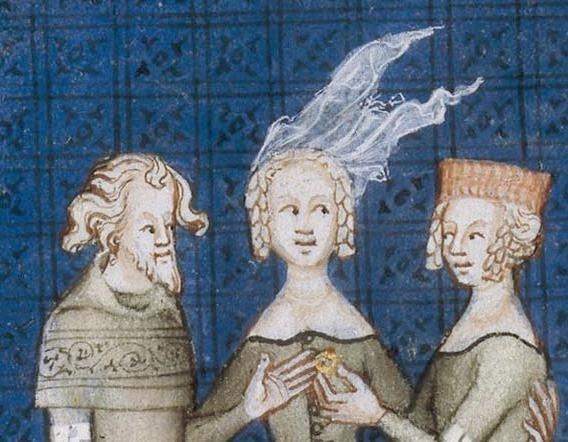
It's funny, I've made rather a lot of clothes for myself over the years, but the only fancy frocks have been late-period Italianate stuff--the quattrocento PURPLE!~ gamurra I made for Kamilla's Laureling, and the bronze-and-green Bronzino-ish sixteenth-century job I made for Kasia's Laureling.  I don't actually have anything north of really nice wool in my own chosen time period.  It is really time to correct that.

As previously noted, I have some heavenly blue silk for the underdress, and some cream-and-gold silk brocade for the overdress (which has just arrived safely, after hurricane delays[1]).  The pattern I used for my new pink linen dress this summer is close enough for jazz, and I can get help tweaking it further this weekend.  However!  I want to actually plan this out for a change, instead of just plowing forward, getting halfway through, and going "...oooer hadn't thought of that, herp derp".

Some topics currently in my thoughts:

  • Will I ever want to wear the blue dress by itself, i.e. without the (or an) overgown? 
    • this informs its closures and, potentially, ornamentation
    • presently thinking: no
  • Elbow or full sleeves for the overgown?
    • presently thinking: elbow, so one can see the blue underneath
  • Embellishments for the overgown?
    • pearls, gems, etc.  There's some evidence for that which we saw in the Opus Anglicanum exhibit, though that might have been associated with the embroideries, not underlying brocade patterns?
    • presently thinking: research it more
  • How to close the overgown?  Lacing, fabric buttons, metal buttons?
    • presently thinking: buttons, inclining towards fabric
      • ugh ugh ugh
  • Line both, neither, or either dress?
    • To be 100% accurate, the overgown and probably the underdress too would be fur-lined.  Not doin' that.
    • presently thinking: neither.  That much silk is going to be sweltering enough as it is, thanks.
  • How much matching up of the brocade do I need to do?
    • presently thinking: across center front and center back; and keep directionality on the gores; everything else is probably gravy
  • Tippets, Y/N?
    • presently thinking: research it more
  • Include machine stitching or do it all by hand?   *record scratch*
    • oooeee.  This enters the misty land of "done" vs "best".  I have clear delineations in other projects--if I'm making something for display, I'll hand-sew it all; if I just need basic clothes to cover one's fleshy bits, I'm fine to machine-stitch where possible--but this is neither the one nor the other. 
    • presently thinking: do it by hand.  But this could change if I suddenly grow a deadline.
And then there's the general need to up my accessories game: hair, veil, possibly belt, etc.  (Though I'm suddenly feeling that in a lot of images of super-fancy ladies, they aren't wearing belts?  Let's check that.)  And oh god my purse needs replacing, my current one being a "temporary kludge" enacted over ten years ago. 


I haven't lost sight of my main objective, i.e. getting the pourpoint out the door; indeed the left sleeve is now attached and has all its buttons, as well as a whole! three! buttonholes! *sob*; but I can work in parallel, and if I don't get moving on this now it'll never happen.


[1] Please donate if you can:
Hispanic Federation for Puerto Rico's recovery from Hurricane Maria

Global Giving's fund for Texas's recovery from Hurricane Harvey


Thursday, September 14, 2017

A Slight Detour Into The Bridal Industry

Motif of ribbon flowers and old lace

I haven't done much historical sewing over the last couple of weeks; partially lack of spoons (the start of semester is always exhausting as all get-out), but chiefly because my needle efforts were concentrated on a Happy Event!  Namely, a wedding dress for a dear friend. 

Let me immediately disclaim any real kudos for this; the artistic genius and much of the execution was in other hands; I was, okay maybe not a plongeur but no higher than a commis, anyways.  But it was exciting and a lot of fun to be part of the project, and the result was not just beautiful in its own right, but completely perfect for the bride in question.  (And, in spite of it being executed entirely in colorways I just can't with, I loved the result.  Magic!)

you have no idea how long the
initial strip of tulle was
The dress is of two parts: an underlayer composed of a corset/longline bra attached to three petticoat layers of tulle (in pink, lavender, and INCREDIBLY SPARKLY GLITTERY silver-grey), and the dress itself of pink/lavender silk with a fine pink net over the bosom and upper arms.  The decorations on the dress were composed of lace motifs cut from the bride's mother's wedding dress and dyed pale grey (both by your humble correspondent); ribbon flowers of various shapes and sizes in pink, lavender, plum, storm grey, and rose, made by the bride herself; and a scattering of pearls, crystal beads, and crystals (grey, purple, and pink).  

In addition to the lace extraction as noted above, my contributions included endless gathering & stitching of miles of deeply annoying tulle; attaching same to the cotton underskirt lining; hemming the underskirt lining; stitching the top of the corset to its lining; a couple other small jobs I'm forgetting; but the most fun was placing and arranging the decorative elements on the dress.  It's all the same kind of fun as decorating a Christmas tree, only more so.

    
part way through the embellishment process
(with designer)

There were some late nights involved, but I didn't caaaaaare.  Everything about the project--the collaboration, the love, the vision, the outcome--was magical.  I'm so happy to have worked on it.

And, of course, the action shot:
happily ever after!


Sunday, August 13, 2017

Post-Pennsic Catch-Up

I promise I'm nearly done with this JPG

Another Pennsic survived, and indeed enjoyed (unlike last year's Bataan Death March).  The weather was, on the whole, nearly perfect; we had a marked decrease in camp drama; our small co-prosperity sub-sphere worked together to correct some problems[1]; and I wasn't killing myself trying to get things done to a deadline...which may be why I actually got some things done.  Mind you, it is still rather a drain to be den mother, hall monitor, and assistant principal to 70 variably-situated people, and I am nearly ready to be done with it so I can enjoy my vacation as a free agent, so I'm hoping to train up a padawan to take over in a couple years.  But let's get to the arty stuff.

Stuff worked on/finished/set on fire:
On Wednesdays, we wear pink.
  • Partlet: Much to my joy, I found that Past Me had actually cut one out already.  I sewed it together and hemmed it in the field, and it was ready for my class Saturday morning, along with--
  • Elizabethan working kirtle: you know, the one I cut out last year and finally finished last month?  Was miles too big around my torso, and also the neckline is kind of verkachte.  Fortunately the partlet covered the latter, and my posse pinned the back seams more tightly so I didn't look like a complete goober.  So, there's some fix work to be done in the fall sewing. (I have more thoughts about the cut for a later post.)
  • Linen Gothic Fitted Dress: I finished it before leaving! other than the eyelets and hemming, which I also did in the field.  I'm particularly smug about it because I did the pattern adjustments on my own & on the fly, which is not at all easy, but my eye is clearly getting better at this.  It too is rather too big, but I'm not 100% sure that's wrong for a working dress; something else I shall expand on in a future post.
  • The Pourpoint: I got the new lower sleeves quilted & pinned before leaving, and I showed the beast in the A&S display, in pieces, as a work in progress (wherein I also got to work on it, at least a bit).  Now it's just $*@&# buttonholes all the way down.
  • Linen Trousers Mk. 2: the first time my dashing consort wore them, he split the seam at the back of the crotch gusset.  I hate pants.  Pants are stupid.
learn and fear these arms!
I also finally got to hang the banner I painted a couple months ago, which is another nice smug feeling.  It is rather a bodge job (I tacked some of the messy edging I'd cut away onto the top as fast-and-dirty ties), and it should really have a pole and all; but this worked for the moment (as it was, I only got it hung up on 2nd Monday) and I can improve it later.  

Speaking of improvements, I now have a list of them for our pavilion; most involve textile printing of some kind.  I missed the series of classes that The Subject Matter Expert was holding--not only was I up to my ass in camp foo, but you needed to bring some materials that I didn't have a prayer of getting together in time--but the Printed Textiles in the Middle Ages FB group is full of info and I am hoping to start with something small and not particularly important; namely covers for our camp coolers, because ugh.  When I have some confidence in the technique, I want to print a canvas floor for the pavilion[2], ideally to look like the tiled floors you see in all the 14th c. illuminations.  And on the non-textile front, we're planning to paint the pavilion poles (not in designs, just colors); and I picked up a plain white folding shelf unit to keep the tent's inside a little less of a rubbish tip, and I want to do some designs on that.  Maybe acanthus leaves, maybe armorial bits, we'll see.  

For the fall schedule, I'm keeping some flex in case I'm needed to help with a wedding dress that's set to launch next month; but the general prioritization looks like this:

1) FINISH. THE. POURPOINT.  AAAAAAAA.
1a) and the test version, too.  oh god more quilting
2) Do the small bits of mending required post-Pennsic.
3) Knock together a new pouch, as the one I made, guh, ten years ago? more? is crappy and falling apart and was only a kludge to begin with.  
4) *deep breath* Make myself a set of high fashion Gothic fitted dresses; the under-dress of the blue silk I got at Birka a few years ago, and the over-dress out of the silk and gold lampas l I just ordered from Sartor.  I need to make something for myself that isn't an experiment or a kludge job.  ...There might end up being pearls on it.  I'm just sayin'.

I'm not going to look past that point for now, but hovering in the parking lot is the bunch of really nice linen we also ordered from Sartor, because for next Pennsic my dashing consort is getting a full kit of Field Gothic.  Currently figuring a blue tunic and ochre hose, and once those are done I'll see what will go well as a hood (maybe a dark red).  And I do want to make him a full-on Modern Maker fancy 16th c. suit, too.

That'll do for awhile.


[1] HEY KIDS INTROVERT SPACE 
[2]  You might think that the next step after that is painting the pavilion itself, but I don't have a strong feeling of what exactly I'd want to do, so Imma let that marinade for awhile

Sunday, July 16, 2017

Work Is Occurring Yes


Many buttons.  Too many buttons.

This post will be more laundry-list and less explicative, because we're into the pre-Pennsic sewing crunch and I have six quarts of boeuf bourguignon to make, vacuum-seal, and freeze today.  So without further ado, here's what I've been up to:

  • Put lacing holes in the late-period suit my ronin-sister made for my dashing consort last year, and added cloth buttons on the front closing of the netherhose.  Which latter was warm-up for...
  • Made all the buttons for the pourpoint.  At least, I hope that fifty-five will be enough.  *thud*  For the flat buttons, I'd bought some felt to insert, but even with two layers (and it's pretty thick felt) the result was still too squishy; so I messed around a bit and found a way to cover the pewter forms I'd gotten for this in the first place.
  • Cut out a new, larger pair of lower sleeves for the pourpoint, which I have to set up & quilt today (something I have been in massive amounts of avoidance about).
  • Made a green linen apron for 16th-century working clothes.  Well, I mean, apron tech hasn't really changed over the medieval period (take a rectangle of fabric. tie it around your waist.  wipe your hands on it.) but we actually see green linen ones as a specific and recurring item in 16c. England, so there it is.  Also I had a bunch of dark green linen. --Now, the truth is, that's probably supposed to be a wearing-out apron and not a grotty-job apron, so I still actually need an apron for doing grotty jobs; but this is not today's problem.  
  • Knocked together a 2nd pair of generic linen trews for my dashing consort, in case it's another stupid hot year.  In spite of redoing the pattern per his feedback on the first pair, somehow they still came out too short-waisted and bind his bits. Snarl.
  • Cut out a linen GFD.  This is not going to be any kind of show piece, it will be machine-sewn oh yes it will, but just something cheery and cool for hot weather in case it's another stupid hot year.  (You sense a theme here?)   Especially since my blue dress is reaching end-of-life.  
I am hoping to complete all of the above items as well as a partlet before we leave; let's see what happens.

Sunday, July 9, 2017

Secret Project REVEALED: A Laurel's Hood

we did a thing!

At last it can be told!  The item I alluded to in earlier posts, that I spent a chunk of this spring on, was presented to its recipient yesterday, so now I can tell you all about it.  

The request was for a 14th-century hood as part of Laurel regalia (in place of a cloak) for Stephan of Silverforge, which would be executed as a team effort between myself and my ronin-sister Ceinwen. We had a pretty free hand, modulo the information that he'd probably rather not something in traditional Laurel green, and that he likes wearing hoods in the wacky late-14th century "chaperon" style (this is where you put the face opening of the hood on top of your head like a hat, drape the mantle along your shoulder, and wrap the liripipe around your temples).  

Design Stage (March-early April)
BNF 1586, folio 56r
Since Stephan's arms are blue and silver/white, we figured to make the hood blue wool with a silver silk lining.  We then went all over the map with decorative design choices...fortunately, in an effort of self-preservation, backing away from the full-on goldwork and needle-painting idea before it got too entrenched in our brains...and agreed on a simple vinework pattern in a band along the lower edge of the hood as one often sees in manuscripts of the era. 
one of the Comminges laurel
wreaths


Ceinwen's initial design sketch
For the wreaths themselves, well, now you know why I was so damn excited about finding those images of the St. Bernard de Comminges cope at the embroidery schola; at last we had solid documentation for 14th-century laurel wreaths!  Woo!  So Ceinwen took those photos and sketched them into a workable design.  The plan was that I'd make the hood, send it to her, and she'd fiddle the design size/orientation to work on the final size and angles of the hood's mantel.  We also considered adding stars and/or swords (elements from Stephan's arms) directly onto the rest of the hood, either as appliquè or as metal "spangles", but that was, as they say, a stretch goal. 

The other major design element, in light of the recipient's chaperon-style tendencies, was to cut the hood's liripipe as laurel leaves, so it would form an actual laurel wreath when he wrapped it around his head.  I'd never made a liripipe before, so why start with something boring and normal? 

Fabric-wise, I had ten yards of a handsome navy twill that I was hoping to use, but twill wasn't going to be a great choice for a cut liripipe unless we lined and/or finished every. single. stupid. leaf; and bugger that for a game of soldiers (and, at that, I'm not sure it was Done).  So, I ordered Wm. Booth's navy blue broadcloth, which, although rather a darker blue than we wanted, was perfect in the weight & behavior department.  I got some silvery-blue silk from the Garment District for the lining, and Ceinwen picked up an exquisite heavy navy blue silk for the embroidered band, and off we went[2]. 


warning: math ahead
Construction Stage (late April-early May)
I based the hood on D10597 of the Greenland finds, which was pretty exact to the proportions Stephan's lady had sent me from one of his current hoods.  I spent an uncomfortable couple of hours with math and many pencil marks converting the 2mm:1cm scale in "Medieval Garments Reconstructed" into Imperial measurements, but got there eventually.   The rest seemed pretty unremarkable--I made a muslin; tested it and it seemed OK; cut out hood & lining; sewed it all up[1], and did a bit of decorative top-stitching with a pale green silk; patted self smugly on the back; and then tried it on my dashing consort.

Whereupon I found the front was horribly, horribly poochy under the neck.  


This was my own stupid fault.  I tried to cut the front part in one to the same size as the pattern, without including the front gore, and it did not work at all.  THE PATTERN EXISTS FOR A REASON, IDIOT.  And them medievals don't shove in gores because they love doing extra seam work. 

After a requisite amount of self-flagellation, I calculated the gore size appropriate to the pattern, cut one out of muslin, opened the front seam sobbing at the destruction of my painstaking handiwork, and pinned the gore in.  It worked with only a little frobbing, thankfully, so I cut out fashion fabric & lining versions and got them sewn in.  (You still see some wrinkles; there will always be a little bit of that, unless you're doing a button-up hood that can be perfectly fitted to the wearer.)


So, the liripipe.  Some of the Greenland hoods, including D10597 have them (though they're all plain).  In most cases they're separate strips that attach to the back of the head, but in D10597's case there's a couple-inch liripipe "stub" on the back of the hood's body that the main liripipe strip is attached to; and since that would make my life considerably easier in any case, I cut the hood out that way, and left the stub open while I figured out how to attack the problem.  


tools of the trade
When you really suck at
drawing, grids help.
I started by looking at what remnants we have.  There are various scrap finds in London that are dagged; it's not clear whether they were liripipes or what, but some certainly could have been (Fig. 180 in Textiles and Clothing is a line drawing of a figure in Cambridge MS 61 f.1v, who's wearing a hood with a dagged liripipe), and the scale of fragment No. 248[3] seemed about right, so I started with its basic dimensions and worked to turn the basic diagonal "slit" dagges into laurel leaves.  (We do have a remnant of what appears to be an oak-leaf dagge, so a botanical motif is not far off.)   

I tried sketching laurel leaves after the embroidery I'd found, but this was working out poorly for me, so I got an actual bay laurel leaf out of the kitchen and traced around it.  Happily, this turned out to be exactly the right proportion for my liripipe!  I made a five-leaf-long repeat of the pattern (which is exactly one sheet of graph paper, imagine that) and cut out a test piece to see how it did. 

Answer: pretty well, actually.  


Proof-of-concept
Emboldened by this success, I cut out the full length of liripipe (which worked out to about 40", as I recall).  Now, I'm not sure this is how it would have been done in period; I'm guessing a plain, thin, straight liripipe would have been all-in-one, but I haven't worked the math as to whether a more wasteful cut like this mightn't have been done in sections.  But I had the fabric, and this is not a poor man's hood, so let's be extravagant.  I cut it out and attached it tightly to the hood "stub", completing this phase of the project (though I was silly and finished the bottom hem of the hood, so we had to cut that open subsequently to attach the embroidery strip, bah).  I boxed it up and sent it along to Ceinwen.

Embroidery Stage (May-early July)
My first wreath.  About 15 hours'
work I think? I'm not very fast.
All I can say about this is, I do not look forward to my turn in the barrel for having to design an embroidery strip to hang neatly and evenly on a three-dimensional conical object, and Ceinwen did an amazing job making that happen (but I'll let her tell you about her process in her blog) (AHEM).  When the design was complete and the goldwork vines established, I went down to Ceinwen's and we did a marathon sweatshop to get the wreaths embroidered.  

Unfortunately we ran out of time, so couldn't add pearls or bezants or bells (yes. there are hoods with bells all over them.), but we got the job done on time for transport to the event.  We figure to steal it back later and fully execute our vision.  Especially the pearls.

As yet, no photos have emerged from the event, but I'll add action shots as they become available.


[1] yes, of course it's all hand-sewn
[2] this is somewhat compressed.  We had a lot of ordering of swatches and mailing them back and forth in here.
[3] acc. no. BC72 <3110/1> but it's not in the MoL's online collection nor can I find an image online because why would we want that


Sunday, June 11, 2017

Mending & Patching


MY KANBANS, LET ME SHOW YOU THEM

Hi, any readers still here!  I've been incredibusy[1] for the last while, but none of it's been interesting new textile explorations that I needed to whine about, and I've been travelling a lot, so lack of postings.  (I actually have a pick-list of general topics I want to burble about, and I need to be better about motivating self to burble about them when I'm not in the middle of a project.

Since last we parted, I've moved, let's see here, eleven cards from "Backlog" to "Done"; each of them representing a task (see graphic above).  Now, a single task might be small and quick (e.g., mending the top of a gore) or a lot of work (e.g., making 50-odd buttons for a pourpoint); but they're still An Thing.   You can also get fancier by estimating effort per task and using that as a filter or pick mechanism, but I usually have an idea just by looking at it, so I haven't bothered shaving that yak.

I used a different method to track the kirtle work (which I've also finished!!)--it's on a single card, but it has ticky-boxes inside the card for each step.  I can see value to both methodologies; I think it really comes down to whether you're more inclined to do one entire project to completion, or to cycle through several in turn.  Since a lot of what I was doing presently was mending/fixing/upgrading, it made sense to have this combo method.   

For the record, I did not stop to resolve the questions I had about the kirtle that I burbled about in the previous post; I just forged ahead and made the thing.  I'll get analysis later, for use with a more serious project.  (I did face the center-front and the neckline with silk bits, the linen being so very fine; I did not bind the neckline or armholes.)
it's less dorky if you sew stuff
in your own underwear

A thing I am slightly smug about: I have classified my chemises.  I have a bunch of shifts and, except for two which I made simultaneously, they're all slightly different in cut and fit, and some work better with some dresses than others; and it's difficult when you're staggering around your tent in the morning to figure this out.  So!  I have tried each on in turn, taken notes of its particular features, and sewed in tiny corresponding numbers at the back of the neckline.  And they're nubbly, so I could even figure it out in the dark.  Ahem.  (And this also means I don't have to fumble around figuring out which side's the front.)  

I may forget what each number represents, yes.

Having finished the kirtle last night, now I suffer the option paralysis of what to pick off the backlog next.   OH HEY I'LL HAVE LUNCH THAT WILL HELP SOLVE THIS no no it will not


[1] I have an English degree and that means I can make up words.


Sunday, May 14, 2017

Various Devils In Details

Nothing to see here, move along

I spent most of the last while working on [REDACTED], and after some few setbacks and, ahem, learning experiences, it's done and I'm tolerably pleased with the result.  Don't worry, I took a bunch of photos and you'll get to hear all about it later, if without the piquancy of my in-the-moment emo.

I have now turned my attention to the linen kirtle I cut out last summer and, like an idiot, was trying to finish at Pennsic, which I want to have done for Quest (which is Memorial Day weekend).  And now that I've hauled it out and started really looking at it instead of just robotically executing "here are the pieces, sew the thing", I have a couple of concerns.  The minor one is easily resolved, at least once there's someone over who can pin me in: the front neckline is wayyyyyy too high.  Like, almost no drop from the shoulder.  I'm not sure how that happened, but it did; but I don't want to try and amend it freehand, but I can assemble the rest of the thing, leave the neckline unfinished, and then have someone mark it on me.  (The back, at least, seems to be in the right place, so I can even close it up to the shoulder seams.)

Somewhat more concerning is that the center fronts are quite curved.  Now, this is perfectly normal for my 14th century stuff; but my understanding of the 16th century is that we're all about the straight lines because we have support happening inside the garment layers[1] and that's going to force your shaping so your pieces can be more cookie-cutter.  Certainly all the example pieces and published patterns have straight fronts, so I think this is Not Right, particularly for a working-class dress.  On the gripping hand, what I need is a passable light linen dress comfortable for the Cambodian summers we've been suffering, so a) does it really matter for this garment since it's not a show piece and b) do I have time to get consultation/help with amending it and c) is it even something that can be amended at this point?  
Um?

It is possible that the answer to all three of those questions is a big whompin' No.  

But to keep my options open as long as possible, I'm going to finish the skirt and attach it (I'm OK with where the bottom of the bodice is hitting) and by that time I'll have a sense of whether I'll be able to tap someone to have a look at it (the usual sewing night this week is prorogued for a birthday celebration).  Or I can start training the dashing consort on how to pin someone in--though when I consider how long it took me to get the knack of it, this may not be helpful for the current undertaking.

Other minor nits that have occurred to me:

  • I had originally planned to bind the neckline with a contrasting linen, but I'm not sure whether this would be appropriate for a working-class under-dress.  On the other hand, I'm mostly going to wear it alone, so a wee bit of ornamentation would not go amiss.  I can't find period guidance either way.
  • do I need a strengthening strip around the skirt waist like we do for cartridge pleating (I think maybe not, because again, working class basic?); 
  • a facing for the center front to strengthen the lacing holes would be smart[2]; 
  • the Tudor Tailor says to self-bind the armholes, rather than other finishing techniques, and I'm wondering why; 
  • I really need to make a shift with a more U-shaped neckline for this late period stuff and also maybe my shifts should be a little longer (a lot of them are barely knee-length)
Of course, after all this, it'll probably be one of the years where Quest is 40 degrees at night and pleasant during the day.  So I'm hedging my bets by finishing the refurbs on at least one pair of my consort's wool Venetians, too.

The Trello board I mentioned in my last post continues to work well; so well, in fact, that it was proposed to me that I could teach a class in Agile Project Management Techniques As Applied to Your A&S Work.  Do we think this would be a useful / valuable thing?  Would it play in Peoria?

In other news, I am engaged in a Kafkaesque struggle to understand what the East Kingdom actually expects of you reporting-wise after you have held an event.  The only thing I've learned is that 1) everyone has a different idea--and I asked some experts, I can tell you--and thus 2) no one really knows for sure.  So I have started to document what I've found, because this is silly.  (I still, after two weeks, do not have an answer of where I'm supposed to send our duly-collected waivers--you know, the ones you're supposed to turn in within ten days.)  Hey, guys?  This kind of disorganization is why more people don't throw events.


[1] or under, for later and fancy rich people
[2] this is, in fact, what suddenly caused me to go HEY FRONT NOT STRAIGHT WHYYYY