Tuesday, March 28, 2017

The Pourpoint Commission: Beta Release

Action shot!

I misunderestimated how much time it would take to reach Minimum Viable Product, which meant a lot of late nights and sewing-over-lunch-hours; but the pourpoint was ready at the time the client wanted it, which was "after court, for the feast".  So, a success, as far as this goes.

Many people were kind enough to comment on how well they thought it looked, but I, of course, can only see the things I want to fix or do better.  Well, and there are some definite actual problems too--in spite of having cut the forearm pieces bigger, they are still an inch too narrow (WTF!?!).  Herewith, a list of items to amend before I hand it off to the client for good[1] at Pennsic:
  • Buttons and buttonholes, duh.  Est. time: 20-25 hours maybe?  I am not super fast with buttonholes and I don't know how long it'll take me to cover/make the buttons.
    • I still have to determine what I'm going to do about the round buttons.  Entirely fabric, like Red Charlie's?  Or solid-core, like the flat buttons definitely are?  AAAAAAA.
  • Re-cut and re-quilt the lower sleeves larger.  6 hours or so.
  • Add the cuff piece that I thought I didn't need 'cause the lower sleeve was long enough when I fit it but isn't now (though, aheheh, I think I can just cut off the bottom of the extant lower sleeves and use that?)  Possibly no time at all.
  • I may have to do a little neckline fiddling once I've lined up the center front properly, which I couldn't do when stitching him in.  A couple hours.
  • I really feel it ought to be a couple inches longer (though I only lost 1/2" from quilting shrinkage, so I guess that was a botch from the word go).  So I'm thinking of quilting strips to sew to the bottom of each body piece.  4 hours?
    • This is a lead-in to a separate irk: the "skirt" of the pourpoint was flaring out in an incorrect fashion.  I am hoping that adding length will help that, but I don't know if that's enough to overcome the forcing-out by the thickness of the padding.  Theoretically, closing up the slits at the hips would fix this; but Gold Charlie has those slits, so...no.  
      • Now, Gold Charlie also has a ton of additional tie points for hose, and if you tied your hose all around that would help drag the skirt down; but this also confuses me 'cause most men's hose designs I've seen only have a single attachment point in front, so I really am not clear WTF is going on here.  I'm going to try at least attaching the two hose points we have a little lower on the body, and see if that makes a diff.
    • It's also too loose around the hips, at that.  Should be more form-fitting to match the imagery.  I don't know how to make that happen without closing the slits, though.
  • And then after these tasks I gotta re-hem it all.  *drinks hemlock*
As a side note, I stuffed the upper chest portion as much as ever the fabric could hold, but it's not getting the pouter-pigeon effect.  I guess we just have to chalk that up as artistic license.  (Or a difference in body shape for dudes whose day job involves living in armor.)  

Oh, and I need to finish the linen test version too.  Probably another 10-12 hours of quilting and a bit more cotton bowing, and then maybe 5 hours of assembly + 12 hours of eyelets.

[1] with occasional borrow-backs for competitions & displays

Sunday, March 19, 2017

The Pourpoint Commission: Coming Around The Clubhouse Turn

This will be a little more perfunctory and less image-enabled, because ain't no one got time for that, and also my phone forgot how to connect to wifi after the March 5 Android patches and this has caused me to use up all my data plan for the month and Google Support has not followed up after "did you try a factory reset?" so uploading photos is not currently a thing.  But at least I SPELLED THE POST TITLE RIGHT AFJDKFJKDFJFJDK

ahem

Right. So, where are we after a week of blitz?  

  • All pieces are quilted except the right front, the two upper sleeves, one lower sleeve, and one back gore
  • One of the two hose ties is made up[1]
  • The upper back & lower back are sewn together (and the seam allowances are finished, TYVM)
This doesn't seem like a great deal of advancement, but to be honest, from an effort perspective we're over the hump.  I have all of today...modulo eating and, ahem, blogging...to put to it; that's probably a good ten hours' work available (well, I already put in an hour this morning finishing up other gores) and then every evening this week.  I have also rethought the order of events--I had intended to spend today quilting the right front piece (and that woulda been the whole day, too, probably), in the instinctive desire to prioritize the most fundamental pieces; but instead I'm going to do the upper sleeves.  Because why?  Because then I can take them into work and set gores over my lunch hour. I will have to jettison my workout routine, but needs must when the devil drives.

An hose tie.  It's made up of the lining linen cut into a forked
strip and then wrapped in silk quilting thread.
There is, as expected, no damn way I'm getting 50+ buttons & buttonholes done by Saturday, even if I farmed out the work; the client is OK with being sewn in for this.  So, the Minimum Viable Product task list, in no particular order: 
  • Quilt remaining pieces
  • Set gores in upper sleeves
  • Sew lower sleeves to upper sleeves
  • Sew front pieces to back (that's two side seams and two shoulder seams)
  • Attach sleeves to body
  • Hem all raw edges (not literally hemstitch)
  • Make up 2nd hose tie
  • Attach hose ties
Other than quilting, probably the slowest part will be closing up the raw edges... In the absolute worst-case scenario, I can do all the long(ish) seams by machine, and then rip 'em out afterwards and redo them properly.  

RIght; breakfast, and then on.

[1] which I did while watching a vendor demo. Who says vendors are a waste of time?


Sunday, March 12, 2017

The Pourpoint Commission: Not So Much "Launch" As "Measured Acceleration"

the cult of Baron Samedi took a
strange turn in some clothworker
guilds

The past week's efforts were somewhat restricted by lacking any pale-colored silk quilting thread, because in my laudable Buy All The Things In Advance effort I had only gotten black thread. because I am genius.  shut up.


I became aware of this resource gap a few hours after last week's post; I had laid out the pattern pieces on the silk to get an idea of how much wiggle room was available, was pleasantly surprised to find a comfortable amount, and cut off (with some wincing and gritted teeth) a 6" square to test-swatch.  I set it all up on a small frame and went "...oh."  I put in a rush order for what I needed--getting both white and natural colors, since I wasn't sure which would look better and I didn't want to go through the same thing a few days later--and proceeded on the test swatch with the black thread I had, because it's a test swatch and who cares?  
Promising, yes.

Pleasant surprise #2: the silk, even when packed much more fully than the linen, didn't have any perceptible lossage either.  That meant I could proceed with cutting out the pattern pieces from the silk without any additional pattern-frobbing, hallelujah.  No; just had to do all the frobbing to make sure the brocade motifs lined up in an agreeable fashion.  This is a) not easy and b) nerve-wracking, particularly the first time around, particularly on fabric this expensive.  Also, my kingdom for space for a table I can cut out fabric on.  oh god my back. 

The rest of the week there wasn't a lot I could do, waiting on the thread arrival, so I stuffed it full of the social engagements I wouldn't have time for once I really got going, and did a few minor tasks, like ensuring I had lining fabric ahem.  I decided to use the Sartor heavy natural linen I had in stash already, because a) it's worthy, b) I have a goodly amount of it since I'd intended to make a dress for me and a suit for Himself out of it, and c) most of the other stuff I have to hand is fine, underwear-weight, and if you're anchoring expensive silk and a pound of cotton floof on it, not to mention OVER FIFTY BUTTONS AFJKDJFKDJFKLJG, I figure you want something a bit more solid.  (And it's not coarse heavy; just heavier than their other stuff, which is rated "fine".)  Regrettably, I have no information about Gold Charlie's lining, other than that it is linen, but I feel this is a reasonable choice.


in media res
I had all my critical resources in place to begin yesterday afternoon, so after doing a stay-stitch around the armhole curves, I got cracking on the upper back piece, which is comparatively easy: it doesn't have to match anything and the motifs line right up down the center back so you have some built-in guidance.  Happily, the brocade motifs are spaced in such a way that, by running the quilting lines along the the top and bottom of the quatrefoil lobes, this works out very close to the 30mm spacing on Gold Charlie.  That'll work for all the large pieces except the lower back, whose lines are on a slight curve, because there is no God[1]; the gores are a mixed bag, and I will worry about them later.

Some observations thus far:


  • I should do the first, centermost line of quilt stitches on each piece with no padding in place, then stuff on either side of it.  That will make life so much easier.  Why did I not think of this sooner.
  • The silk quilting thread is annoying as hell and wants to be waxed, which I was reluctant to do with silk, but a) it's unravelling and b) it's knotting itself up.
  • Switching to a finer needle makes a huuuuge difference here.  My usual quilting betweens were just not doing it.
  • Instead of laying out everything on a big-ass piece of lining fabric and just "scrolling" it into place on the frame, I'm breaking it down into smaller pieces.  This is going to be considerably more profligate with the lining fabric, but I have some compelling reasons:
    • I don't want already-done pieces of the garment to get smooshed under the frame holders.  This is no big deal for a linen garment but I don't want to get marks on the silk.
      • the downside is, I'll have some uncomfortable sessions getting to the center of the frame with my little T-rex arms, sigh.
    • It's easier to manage the frame if there isn't 2 yards of excess linen drooping around it in all directions.
    • I'll take some of the waste fabric, as available, and put it on the small frame to do the gores.  This also makes my project a little more portable. As long as I'm going to a place that has an embroidery frame stand. -_-
I also had the inspiration to outsource the cotton bowing to an under-employed friend, who is coming up today to do that thing.  I am pleased with my Very Medieval Solution to my critical lack-of-time problem.  Warning: do not come near my living room today.

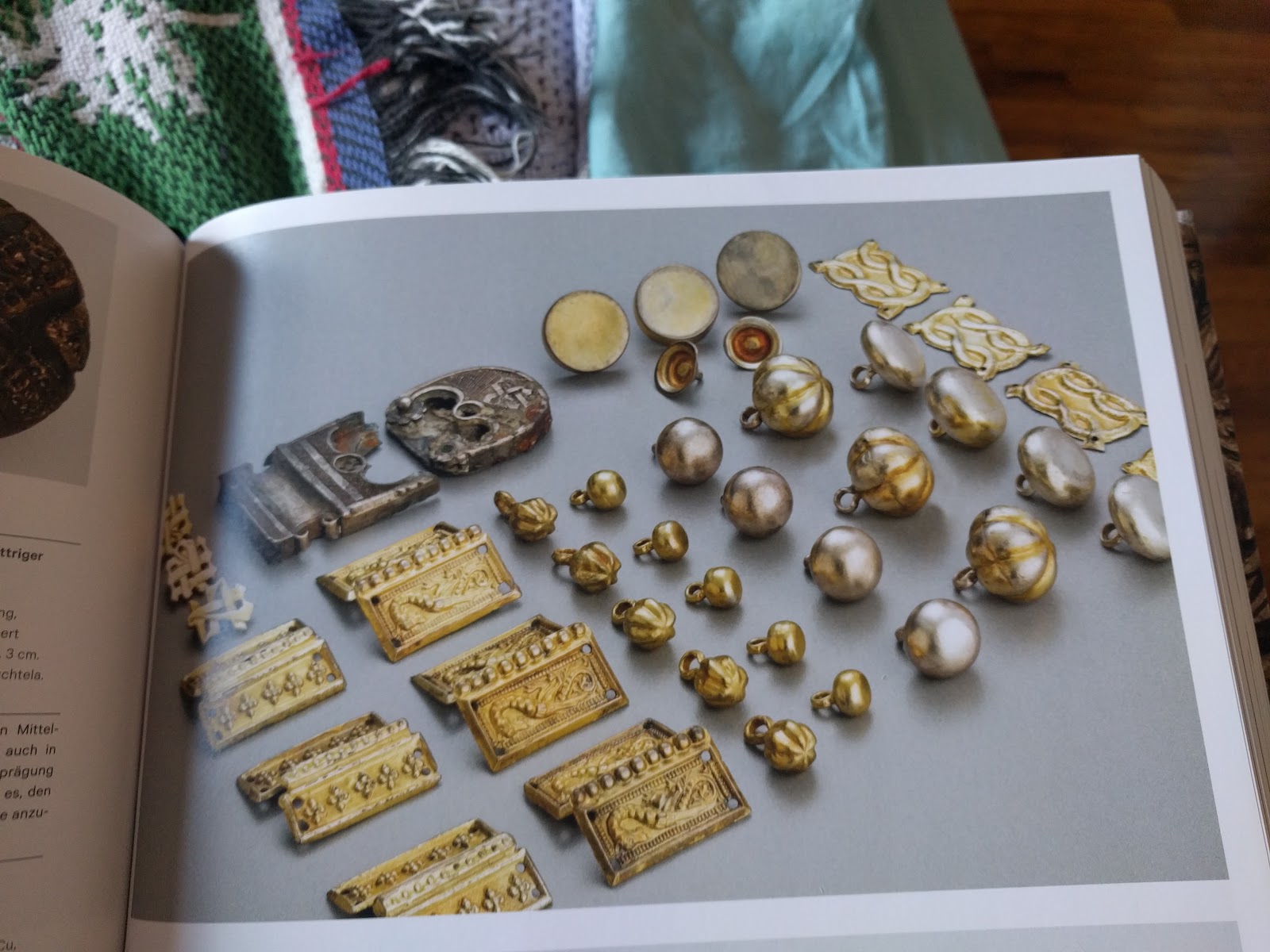
I still haven't found a solution for the round buttons.  I checked all the usual vendors and so far have come up empty.  I wonder if only the disc buttons are metal underneath?  I wonder if the Charles IV exhibition people made assumptions because they found a bunch of metal buttons too?  WHY WILL NO ONE PUBLISH GOLD CHARLIE?

Current music: the Deadpool soundtrack. On auto-repeat.

[1] Actually it's because of the interesting shape of the waist seam at the back; once the upper & lower backs are attached, the curved lines look straight.  I have not taken the time to suss out why this arrangement is better than a straight seam. 

Sunday, March 5, 2017

The Pourpoint Commission: It's Go Time


"It's 21 days to Mudthaw, we have six metres of
Sartor silk, four pounds of raw cotton, society
is collapsing and we have day jobs."  "Hit it."

After days of obsessive activity somewhat interrupted by being gone for a week for a work conference, I got enough of the test pourpoint together--i.e. the body + left arm, which is my patron's dominant side--for a fitting yesterday afternoon, and mirabile dictu, we are actually in pretty good shape here.  I need to add a little extra around the midsection (behold the difference between a human animal in summer and winter) and a little extra around the forearm muscle; no huhu.  My only concern is the way the front gore fits, which looks a little bunchy and puffy.  I took consultation with my panel of experts on how best to fiddle this, and by moving the seam inwards a little on the gore, it should do better.  (Viewers will note that there is some bunching under the armpit, which is true; this is a consequence of both the padding and the extra fabric needed to get the range of motion which is the whole point of the grande assiette sleeve.  So, that's okay.)  


It was interesting to note the difference in padding thickness on the pieces, as well.  The ones I had done first (the back) were much less full than the ones I did last (the sleeve & gores).  This wasn't at all intentional, and indeed I wasn't even conscious of it as I was working.  I think it's a combination of early trepidation + later confidence; at first, I was afraid of over-padding and turning it into a ski jacket, and with each successive piece I was worrying less about that and just instinctively adding Enough Padding To Make It Look Right.  And, as it is, I think I will want to up the levels even more, particularly across the upper chest.  

So.  Hurray.  We pass unit testing.  Guess what that means:  Time to do the real piece. And I am determined to have this in wearable state for the patron on March 25, which is an important event for him.  Possibly this is madness; though minimum-viable-product is having the garment done except the OVER FIFTY BUTTONS AND BUTTONHOLES AFJKDJFKDJFKLJG and sew him into it for the day, which reduces the number of required hours by a significant factor.  We'll see how it goes. 

aaaaaaaaaaaa I am being
trusted with this
Some thoughts:

  • The big elephant in the room is, how differently will the silk behave in the quilting process?  I had no lossage due to padding on the test unit, but I'm pretty sure this is because linen is mad stretchy.  Silk is not.  And we do not have much, if any, excess fabric here to screw around with.
  • How best to do the sleeves is an open question yet.  The pattern instructs you to assemble the upper sleeve (i.e., insert the gores) and then quilt it all down together; and I started with that, and then looked at the now somewhat three-dimensional item, and could not see how it could be done on a stretched-flat quilting frame.  So I took it apart, quilted each piece individually, and then assembled them.  This worked--though if you think setting a gore is hard, try doing it when all the pieces are thickly padded--but it wasn't the best or neatest.  Beth opined it could be done post-assembly by hand, sans frame, but I'm not convinced that'll end well for me. 
    • also, damn do I wish I had gotten to the serious quilting before I went to see Gold Charlie.  I have a whole list of things I would look at more closely now.
  • I estimate that 450g-500g of cotton is probably about right for padding one courtly pourpoint.  I still have a good bit left of my first batch of bowing, but a) I haven't quilted the right sleeve pieces yet and b) as noted earlier I should've used a lot more on the body pieces at least.
  • Mem: make sure the quilting lines will line up with each other across the center front.
  • I have been advised to balance the pattern of the brocade on the different pieces.  The medievals weren't obsessed with perfect matching like we moderns are, but if you look at Gold Charlie, they didn't just slap the pieces together willy-nilly either.  
  •  I did order some 5/8" buttons; the flat ones will do the job for the lower front, but the domed ones are right out.  I need actually round buttons for the sleeves & upper torso.  
  • oh hey let's make sure I have enough plain white linen in stock for lining this
The next order of operations is to lay out all the pattern pieces on the silk, getting the brocade lined up and all, so I see exactly how much extra I have to play with for testing purposes (and for covering 50+ buttons, fjdklajfdklajflajfakdkjagfdf).  If I have enough extra, I'll quilt say a 6" test swatch and see what our stretch factor is.  --Oh hey.  I could do the test swatch, and then disassemble it and use that for covering buttons, if I absolutely had to.  

ora pro me


Saturday, February 18, 2017

The Pourpoint Commission: The Long Dark Night of the Quilting

Current status: 
Quilting.  Lots of quilting.  It will never end. I have binge-watched the LOTR trilogy and am working my way through Daredevil and I still have a long way to go.  However, I want to capture a few thoughts in media res.
Where we started

  • The PVC quilting frame is sufficient unto the purpose--I could not do the project without a frame, that's very clear--and the break-down-ability is a critical success factor for my environment.  But, this comes at a cost: I have to keep pulling the fabric tight (somewhat minor nit), and the pipes come loose from their corner joins every time I shift the frame at all (irritating AF).
  • The ordinary quilting wisdom definitely applies here: start in the middle of the piece and work towards the edge.  Things get wonky if you don't, even if you think everything's pinned down right and tight.  
  • I'm using Wm. Booth's 60/2 unbleached linen thread for the quilting.  I think it's a little more coarse than is quite right, and also it is showing up super obviously against the dark green fashion fabric; but it's working just fine.
  • It's very hard to judge whether I'm getting the same padding thickness from piece to piece (or even on the same piece, betimes).  I expect this is one of those cases where, if it's your whole career, it becomes second nature to eyeball it. 
  • After, hm, 16 hours of work I think?, I have finished quilting both back pieces and most of the right front, and my current best rate is about 6" of quilting in 10 minutes.  That rate is unsustainable for long periods, though, because your eyeballs start aching.
  • I really need to find metal button forms ASAP. I may be able to kludge some of the 18th/19th century repro stuff for this--they'll get covered with fabric anyways.  But I need to prioritize lining up some test objects.
Back to work.

[1] This issue is exacerbated by some already-done parts getting smushed down by the clamps at the side of the frame, as I have to adjust the working area.

Sunday, February 5, 2017

Much Brain, Little Progress


YASSSS GOLD CHARLIE IN PERSON

It's been awhile.   Part of this has been The Holidays, part of it two lurgies (the second one culminating in a mondo sinus infection that I'm still taking antibiotics for), part of it was, well, okay, *humblebrag* a trip to Germany where I got to see Gold Charlie (!!!1!), along with many other of our favorite hits.  But to be entirely candid, my absence of either writing or, y'know, actual productivity has been the socio-political situation of the nation.  I spend a lot of my time in states of rage or despair or both, and when I try to muster my forces to do something artistic or creative I am swamped with feelings of "what does this matter when the world is on fire?".  I am working to retool my brain in this, because a) I have made commitments to people, b) mental health requires both downtime and creative time, and c) fuck these assholes[1] I'm gonna make things[2].   

I did make some small progress on the pourpoint over the hols; I bowed 500 grams of cotton, which took two movies[3] to do (including rest breaks, which there were many of).  I've ordered proper linen and silk sewing thread for the quilting work. And, I've re-stretched my base linen on the frame, but without setting it up completely, so the cats can't use it as a hammock; so all I have to do is pop the top part onto the standing part, and go.  (Goal is to make the setup and takedown easy enough that I can get a reasonable amount done in an evening.)


This is the photo from the exhibition catalogue;
the buttons in question are the three at center top.
You can't see in this shot, but they have shanks that
are about the same as the ones below them.
My trip as relating to the Pourpoint Commission:  Well, I got to see Gold Charlie, obvs.  It being in a special exhibition, of course I couldn't take photos (I snuck the one up top, as you do), but to be honest, the way he was on display meant that there wasn't a lot to see that I didn't already know, either from books or from standing on the shoulders of giants.  Now, had we been able to see his inside... But it was still a highlight and I got all giddy.  More immediately useful, however, was a display in the same case, of various buttons and belt bits dug up in Prague.  These included some flat metal button forms which, the label text contended, were the same as the flat buttons on Gold Charlie (fabric-covered, obviously).  Pressing my nose to the glass, I think they have the right of it.  So I need to find a source to approximate those.  (They didn't specify anything regarding the round buttons on his top part, but they also look to have a firm base, so I assume those are probably metal as well.)  I did also buy the enormous companion book to the exhibition, which is entirely auf Deutsch; from what I puzzle out on Gold Charlie's entry, they only mention the use of linen thread, which seems off to me; from all I've observed, the medievals seem to prefer like thread to like fabric--as previously noted, the Black Prince's jupon[4], silk velvet, uses silk thread for quilting.  (Red Charlie has silk thread on his outer, silk layer, and linen thread on his linen inner layer.) What I figure to do is use linen thread on the linen test unit, and silk thread on the final project.  

Editorial and possibly too-judgy note: I do not for the life of me see how anyone can look at Gold Charlie and think those quilting lines are an after-market conservation add.  Maybe it depends on how he'd been displayed in the past; I dunno.


Passementerie crown from a
reliquary of Kunegunde; 14th
century.  Super nifty. Again,
photo from catalogue
But! This was only a fraction of my adventures.  We went to Bamberg Cathedral and the Diocesan Museum there, where lives the Star Mantle of Henry II (and several other big muckin' embroidered things attributed to him and Kunegunde), and the entire burial suit of an 11th-century bishop--none of which you can take photos of, I may add; I bought the book but it's not super great for pictures.   The Germanisches Nationalmuseum has, of course, a hojillion other medieval stuffs, even if a bunch of them are not on display at any given time; but my old buddy the heraldic embroidered pouch was out and I got many, many photos of him.  (Including the details of how his tablet-woven edges work, woo hoo.)  I feel like I could give a paper just on his construction details (though I may need help from the more expert tablet weavers for specifics of the pattern because I'm not very good at this game yet).  And there's a bunch of stuff in the Imperial Castle Museum in Nuremberg--most of it not textile or costume related, it's true, but good general aesthetic (lots of arms & armor, too, for the people into that stuff).  And we day-tripped to Munich and went to the Bayerisches Nationalmuseum, which has TWO WHOLE ROOMS of nothing but medieval textiles.  I am a failure at getting details of these, because with a few exceptions there were no labels next to the pieces, just on giant unwieldly cards in pockets at the corner of the room (and entirely in German); and very little of this stuff is in their online collection. -_-  But I got many photos and we can always cross-reference with the book which they had in the room but not in the gift shop, wtf you guys.   


Kinda small but
click through, you'll
see what I mean
I also saw a lot of art in various media that was capturing the 14th century beau ideal; particularly the Schöner Brunnen in Nuremberg's town square, which is actually original--something I didn't realize at first, because it's in such perfect condition, especially when you consider that most of Nuremberg was completely pulverized in WWII.  But it's covered with Important Figures in a range of outfits--the nine worthies are in high fashion, prophets and philosophers are in more modest clothing, etc.   And here's a thing, my Gothic peeps: all the high-fashion gents, not just here but all over, have the big plaque-like hip belt we're used to seeing; but many of them also have a similar but smaller belt around the wasped portion of the waist.  It seems to be entirely decorative, not functional--pouches and daggers and things are always hanging off the hip belt--but it's all over the place.  (And it's definitely a belt; I got a photo of a St. George in the round that shows its buckle and strap in back.)  Thoughts?

Anyways, getting back on the wagon: today I need to sketch out some ideas for [REDACTED], which is a team project with a longer fuse, but we want to get our designs settled & approved so we can appropriately source materials and plan out the work.  After that, I'm going to crack the whip and get quiltin'.  I want to have the final of the pourpoint commission done for Mudthaw, which is March 25th.  This was a lot more plausible before I lost most of January to being sick; but if I could do the 19th Century Project in two months, by the Lord Harry[5] I can do this.  

Current music: Pink Floyd, "On the Turning Away"

[1] Seriously: Michael Cohen, Trump's lawyer, was insinuating that the pussyhats were mass-produced in overseas sweatshops.  Because dead white guys can't understand that we create things.
[2] I was away during the Pussyhat Project, to my sorrow, but I have procured two different yarns--one acid green, one flesh-and-dark-green, to make brain hats for the March for Science on Earth Day.  
[3] Ladyhawke and Watership Down, if you really wanna work out the exact times
[4] What should we label this?  Heraldic Eddie?   Just plain ol' Eddie, since there's only one of him?
[5] I am trying to become less potty-mouthed, and find interesting oaths to use instead.

Sunday, December 11, 2016

A Little Pourpoint, A Few Museums

ahem

Following the head-clearing of the most recent post, I hitched up my belt and decided to just start somewhere; this is the test piece after all, and if it's not perfect, that's okay.  And since I am pretty clear on what's going on with the body pieces at least, that seemed like a good place to start.  


Marking the quilting lines on the
LB piece
I laid out my base linen and transferred the body pattern pieces[1] (left front, right front, upper back, lower back) onto it, incorporating the various notes and adjustments[2] from the muslin; a process that, once again, makes me long for a) a large table, b) a light-box, and/or at the very least c) pattern weights.  Then I moved it to the ironing board[3] and, just for the first piece I'm going to work (the lower back, which is the least significant piece) marked the seam allowance & quilting lines there.  Now, Gold Charlie's quilting lines are 3.4cm apart; this is about 1 inches.  My gridded ruler doesn't do thirds, so I started with 1¼; that looked too narrow, so I went up to 1½. Once that was done, I got the whole linen length onto the frame.

if you think these lines look cock-
eyed, you are entirely correct
With some labor, I got the whole thing under good tension, and then looking at the LB piece I saw that the lines were quite uneven, in spite of using a gridded ruler to mark the center line (which instead wandered off to something more like Manhattan-north) and all my other careful efforts.  Grumble.  So, spent some time redoing that.  Then I cut out the fashion-fabric linen for the lower back.  This was the end of the evening on a Saturday, so I figured as how to leave it set up; get to bowing cotton on Sunday; and hopefully be able to quilt a bit several evenings of the week.

Unfortunately I did not take lessons from my wiser and more experienced friends; and I woke up to an Earth-Shattering Kaboom and learned that although this cat hammock could take one cat, it couldn't take both of them.


AHEM
I lost my momentum at this point and put the whole thing aside for several days.  About the time I was ready to buckle down again, I cleverly fell down our building's stairs and committed various indignities to my shoulder and wrists, which made bow operation impossible for several more days.  And now we're into the pre-holiday whirl.  Argh.  

That said, I did get some medieval head-feeding going on!  I went up to my sister's outside Boston for Thanksgiving, and she thoughtfully provided for my entertainment with a trip to the Peabody-Essex Museum, an institution I had been entirely unfamiliar with.  They are notable for having one of the best collections of Asian art in the US (including an entire Chinese house); but our trip was for an exhibition on shoes, put together by the V&A, with some local additions--the Peabody Essex also has a huge shoe collection (who knew?).  So I would have enjoyed the heck out of it to begin with; but imagine my surprise and delight to find some period shoon I hadn't seen before:


14th-century poulaine. That is one narrow-looking
sole if you ask me
Tudor shoe.  Note the nice big toe box. No bunions
for these guys.
And then, the weekend following, we went down to Baltimore to the Walters Art Museum, another institution I had been entirely unfamiliar with (do you sense a pattern?).  This trip was triggered in an unusual, possibly unique, manner; when we were at the V&A in October, a whole bunch of cases in their medieval rooms had little "sorry!" notes to state that this or that piece had been lent to the Walters for their "A Feast for the Senses" exhibition.  By the sixth or seventh of these, we looked at each other and said "well OK, I guess we're going to Baltimore"; and so we got us up a convoy and did so.  It develops that the Walters has one of the best medieval collections in the US (how the hell did I not know this?!), so even without the special exhibition it would have been entirely worth the trip.  But! The special exhibition is exceedingly well done, and I heartily recommend it to your attention, if you can fit it into your holiday schedule (it closes Jan. 8).  No photos, naturally, but the exhibition catalogue is nice.


[1] Does the fabric grain cease to matter (in a structural sense) in a case like this, because of all the padding & quilting holding everything in alignment?

[2] Marking on the ironing board was a horrible choice for a host of reasons, including "squishy board cover", "not being able to have the whole piece flat at the same time", and "insufficient light".  I should have done it on the floor, or possibly once the piece was stretched on the frame (which is where I ended up re-doing it).

[3] NB: I did not make any changes in the pattern pieces to account for the quilting.  On the test swatch, there was no difference side-to-side, and less than a half-inch top-to-bottom; and I expect to quilt the piece less fully than the swatch.  Let's see what happens!